The nervous system
The nervous system is responsible for receiving and processing all the information in the body. It is divided into two distinct sections, the central nervous system (CNS) which is comprised of the brain and spinal cord, and the peripheral nervous system (PNS) which is comprised of all our sensory organs and the nerves that connect them to the CNS. Though the structural formation of the nervous system is similar between people, they are also very unique, for the way that we as people are seems to be very much based around the slight differences in these structures.
How does the nervous system communicate?
The Nervous system is made up of two basic cells, The Neuron that transmit the message and the Glial cells that support them. The basic ‘design’ of a neuron is alike; however, like most cells in the body, neurons will be specialised to their specific role.
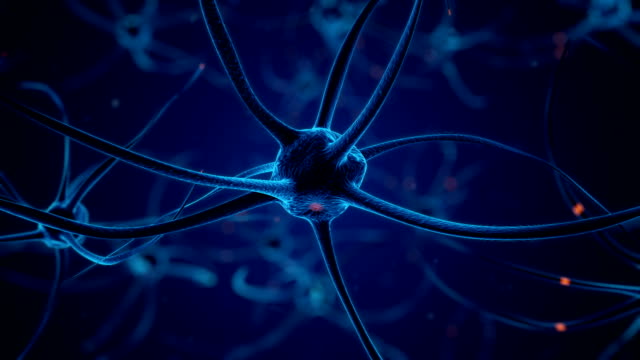
The neuron can be split into 3 parts: the antennae like fibrils called dendrites, the cell body which is where the nucleus of the neuron is and is used to provide energy to drive the neuronal activities, and the axon which is a long tail like structure that conducts an electrical signal to the other neurons (or whatever organ they innervate).
Now the basic way that the nervous system works is that the sensory receptors in say the eye perceive something (such as a ball flying toward you). The sensory receptor will send a signal (called an impulse) through its sensory neuron, the impulse will travel down its axon, that may then pass onto another neuron (through the dendrites, cell body and then down the axon of this neuron) until at some point it will reach the brain (in the case of the eye this will be to the visual cortex) where the brain will interpret what it sees. This impulse doesn’t just stay in the visual cortex but will be transmitted to other parts of the brain where it is interpreted and a decision is made about, what this input is, whether something needs to be done about it, and how can this be carried out. If it is decided that something does indeed need to be done, the brain will send an impulse down a motor neuron to the arm and the hand and the fingers to innervate whatever action it has designated (hopefully the catching of the ball.)
Alongside the sensory and motor neurons are the interneurons, these interneurons are the most common type of neuron and can pass signals directly from the sensory neuron to the motor neuron. They can form complex circuits that help us react to external stimuli. An example of interneurons in action is if you touch something hot. The sensory neurons in the finger send a signal to the interneurons in the spine, which will then relay some signals straight back into motor neurons in your hand causing them to move. Other signals will be relayed from the interneurons to the pain centres of the brain.
Now these impulses that are sent throughout the neurons are not as simple as singular electrical messages. These impulses are made by incredibly rapid depolarisation and repolarisation (basically a change in the electrical potential within the cell from negative to positive and then back again) of the membrane potential within the neuron which will make something called an action potential (AP). These APs can travel down their Axon at very fast speeds. Imagine this AP as an electrical message that just trundles (at break neck speed) down this road [7].
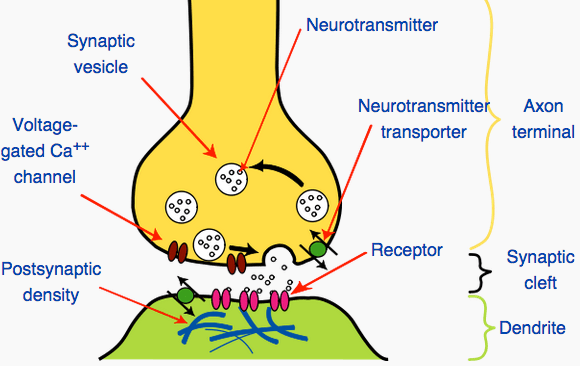
Another problem occurs when there is a gap between the two neurons (such as when the axon meets the adjacent neurons dendrites). This gap is called a synapse. The bodies way of solving this is by the use of Neurotransmitters (NT). These are chemicals that are released from the pre-synaptic neuron when the AP reaches the end of the neuron. These NTs (such as dopamine) then make their way across the synaptic ‘abyss’ where they attach to the post-synaptic neuron which in turn causes another action potential in the next neuron.
TO BE FINISHED…
 Wired Together
Pingback: Pharm to Table – Wired Together