

Introduction
I found it reasonably tricky to really know how to separate this post into what’s actually important. Alcohol to me is a weird substance both chemically and socially I suppose. The culture surrounding alcohol is very different all around the world, but speaking from the perspective of the UK, it is very unhealthy/binge related. There seems to be this idea that alcohol is not that dangerous, that perhaps the worst that can happen is just some embarrassing memories (or lack thereof) and is regaled as a sort of rite of passage to adult-hood but this is not true. I mean putting aside the chemical effects for a second, it seems crazy that we have socially formulated this idea and positively look forward to being old enough to legally liquidate our brains slowly and ritualistically. But anyway, that’s not really what this post is about. It’s mainly about 3 things. One, how does alcohol affect the brian from a bio-chemical perspective (mostly on neurotransmitters). Two, what (broad) effects does alcohol have on different brain regions (ie with short term usage). Three, the dangers of alcohol on the brain (I.e long term use and addiction).
Alcohols effects on neurotransmitters
Alcohol is a type of substance known as a central nervous system depressant (CNS Depressant), and can effect our brain chemistry primarily by altering the affects of neurotransmitters. Neurotransmitters can be either excitatory or inhibitory. Excitatory neurotransmitters stimulate brain activity, inhibitory neurotransmitters suppress it.
Alcohol works primarily in two ways: it increases the effects of the inhibitory neurotransmitter GABA and also inhibits the excitatory neurotransmitter Glutamate. As well as its role on GABA and Glutamate alcohol facilitates dopamine release and also acts on channels in the synaptic membrane, all of these effects can cause short term problems as well as long-term damage.
GABA

GABA (which stands for Gamma Aminobutyric Acid – but who would bother calling it that) is a neurotransmitter in the brain that decreases the activity in the nervous system, its natural function is to reduce the activity of the neurons it binds to by inhibiting/blocking their signal. It is believed GABA can generally reduce our fear/stress due to overexcited neurons. This is why it is the target of a lot of depressant drugs such as benzodiazepines (such as Valium and Xanax) and also where alcohol has its effect. By increasing the amount of GABA in the brain it may feel like a stress reliever and may act to kind of slow everything down; however, it also causes this sluggish movement, poor motor function and slurred speech associated with alcohol consumption.
Glutamate

Glutamate is a neurotransmitter that basically does the opposite it makes neurons excited, hence being called an excitatory neurotransmitter. It increases brain activity and is involved in many cognitive functions such as learning and memory. It also seems like the optimum balance of Glutamate is important as too much glutamate release leads to seizures and death of brain cells and too little glutamate leads to psychosis coma and death. What alcohol does is actually inhibit the amount of Glutamate released thus decreasing levels, supressing this stimulant results in a similar type of physiological slowdown as seen with GABA increase. It is therefore understandable why alcohol is regarded as a general depressant.
Dopamine
What alcohol also does (like many other drugs) is increase the amount of dopamine in the brain. Dopamine basically gives us the feeling of pleasure (particularly in the ventral striatum, including a pathway from the ventral tegmental area (VTA) though the nucleus accumbens and to the pre-frontal cortex (PFC) – not important for understanding is just a pathway that causes the feeling of pleasure). We (hopefully) feel pleasure a-lot of the time, and should happen during any “pleasurable activity”, from getting a promotion to seeing friends or gaming, gambling or taking crack. This feeling of pleasure that alcohol provides (when used frequently) is what causes so many to become addicted. Alcohol tells your brain that you feel great! You like feeling great and so continue to ply your brain with this feel-great-smoothie. Now your brain gets more and more used to being made to feel great every day that it gains a tolerance to this substance.
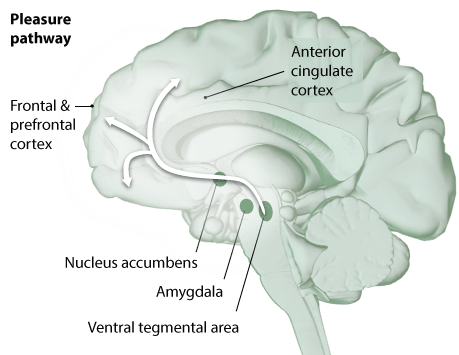
Now it takes more alcohol than it used to, to make you feel as good. The brain has stopped producing as much natural dopamine because it’s used to just being given it daily. Now other things that used to give you pleasure, just aren’t as pleasurable and the only thing to satisfy that itch is alcohol. When you don’t drink you feel awful, and so you self-medicate with alcohol to feel okay again. This is why it’s so hard to get over an addiction, because you are no longer drinking to feel good, you are drinking to just feel normal.
(This idea of dopamine release is crucial to almost any addiction – if you want to learn more about how addiction works in more detail see here.)
Voltage Dependant Calcium Channels (VDCCs)
Alcohol can also work on channels in the presynaptic membrane called the voltage dependant calcium channels (VDCCs). VDCCs are used at the pre-synaptic neuron to facilitate the release of neurotransmitters across the synapse. Alcohol blocks these channels and stops calcium from being released.
Now if we look at this in terms of addiction, we saw that when the brain was pumped with a dopamine releasing substance it couldn’t release as much without it. The same sort of thing happens here. The neuron can’t release calcium because the channels are blocked, so it makes more channels so that calcium can still be released (this provides tolerance to the drug – then you drink more). This process repeats until there is a huge excess of VDCCs (most of which are blocked) to release the required calcium into the neuron.
Now let’s imagine that you stop drinking suddenly, these VDCCs will no longer be blocked and there will be a huge influx (entry) of calcium into the neuron. The neuron will be flooded with way more calcium than it needs and this calcium will cause too much release of neurotransmitter to activate other neurons. Neurons that were usually just about stimulated into action are now completely overexcited and can lead to withdrawal symptoms like: Tremor, nausea, fever, sweating, hallucinations and sometimes seizures. It seems quite clear how these symptoms are cause, if alcohol normally depresses our brain activity and increases the mechanisms (like calcium release) to be able to function normally. When you remove the alcohol the brain activity will be overloaded thus causing these symptoms associated with overstimulation.
Regions of the Brain that Alcohol affects
Now that we have looked at how alcohol affects the biochemistry of the brain, let’s move onto some of the regions of the brain that alcohol actually acts on each time you drink and what effects this will have in the short term. after-this we will look at the permanent effects drinking has when it is done frequently.

Frontal Lobes
Let’s start with some mild drinking, you have a pint maybe some wine and you feel a bit giggly, you start to feel the stress ebb away, and so it begins. Alcohol will start to general impair many functions of the frontal lobes which are in control of processes such as memory, cognition and judgement. So even information from our sensory receptors such as eyes and ears are slowed down, just slowly shutting off our understanding of what is going on around us. The frontal lobes also contain the prefrontal cortex (PFC). The PFC is an area of the brain that is highly developed in higher primates such as humans, it’s an area of our brain that is involved in a wide variety of executive function. It takes inputs from many regions of the brain and then adapts according to the inputs, making a final decision on what to do.
A part of this function is called inhibitory control. This is a cognitive process that permits an individual to inhibit their natural impulses or behavioural responses (prepontent responses). Essentially, it’s a function of the brain that allows us to say no. For example: You are presented with a rewarding stimulus – like some chocolate or some shots or whatever floats your boat. Without inhibition, a person might have an automatic response to just take it. The inhibitory controls allow us to evaluate this decision with regard to other functions like internal plans or general awareness (such as a diet or work the next day) and will then allow us to inhibit this response.
What alcohol does is actually depress this inhibitory response, making a person less inhibited. This means that a person is more likely to engage in foolishness without being able to inhibit their behaviours acceptable. You don’t need neuroscience to visualise this depression of inhibitory control. Alcohol makes a normally cautious and shy person turn into a table dancing, cone stealing, MacDonald’s eating, loud-mouth, who will more than likely stagger across roads without looking. This also means that once you have had your first drink it will probably make it harder and harder to say no to the subsequent rounds.
Cerebellum
Now you have had a couple of drinks, started to let go and loose some inhibition. Next the Alcohol will affect the Cerebellum which is involved with movement and coordination. The cerebellum is the little area at the back of the brain (literally translated from Latin as “little brain”) even though the cerebellum is quite small it consists of a number of subdivisions controlling or facilitating different behavioural functions. One of these areas called the Vermis (named so because of its worm-like appearance) the vermis is involved with movement and balance and are especially useful in the refinement of coordination. At this level of moderate alcohol consumption you will be feeling some postural instability maybe the characteristic staggering and will have some general incoordination.
Hypothalamus and Amygdala
Now you have had quite a few drinks, you came out for one drink but now you are six G&Ts down (and maybe some shots but you can’t remember) you’ve danced and fallen over and smoked a cigarette (even though you said you wouldn’t). The alcohol is now affecting other areas that relate to emotional response such as the hypothalamus and amygdala. You are now more likely to misinterpret people, maybe have a-little cry, perhaps fight that man in the street because he looked at you funny, you have turned from happy tipsy to angry drunk.
The amygdala is an interesting area buried deep within our brain that specialise in the linking of emotions to memories. The amygdala is responsible for the perceptions of emotions such as anger and sadness as well as regulation of aggression. It allows us to combine feelings with rational thought or experiences, so that we can be better prepared the next time. It allows us to be nervous in situations that might harm us and feel positive in good situations. It can also go wrong leaving us fearful of things we shouldn’t be that really don’t make sense, like clowns or the dark or autism from vaccines. Alcohol seems to inhibit the ability of the amygdala to attach the right feelings to situations. There is also evidence suggesting that alcohol inhibits the ability in heavy drinkers to process emotional faces, this may be due to the coupling between the amygdala and the orbito-frontal cortex.
The hypothalamus (and pituitary) control automatic brain functions and hormone release. A consequence of alcohol consumption on this is how it depresses nerve function in the hypothalamus that control sexual arousal and performance. So ironically sexual urge may increase, sexual performance will most certainly decrease.
Medulla
Now we have reached some heavy levels of drinking, you have drunk more alcohol than you ever thought was possible. At this point you are probably even beyond conscious thought. The alcohol is impairing the function of the medulla oblongata. This section of the brainstem controls basic vital life functions such as breathing, consciousness and heart rate. You have now reached “we should probably put you in an Uber, actually no, call an ambulance” level of drunk where you can ruminate on the mistake of drinking while they pump out your stomach. Alcohols depressant effects on the medulla is often responsible for the fatal signs of overdose such as respiratory depression and slowed heartbeat. This requires quite a substantial amount of drinking in one sitting (well for most people) and can lead to this blackout level of drunk. (so in all seriousness if someone is this drunk and they don’t even respond, then do call an ambulance – and don’t let them sleep on their back. equally just don’t drink that much).
Its true alcohol does make you younger! Unfortunately, not by making you look any younger… Instead it slowly deadens your brains capabilities until you reach the state where the bodies just playing Russian-roulette for which basic brain function it can remove but still keep you alive. In a competition with a new-born child for who can balance on their feet and formulate basic sounds, I would put my money on the child. I mean the fact that the vast majority of the UK population consumes a substance like this so frequently that one of the hallmarks of our society is the crucial existence and age-old tradition of going to the pub is baffling. Its probably never going to change, something so engrained in our way of life have always proven hard to remove. Brits occupy pubs in the same way Americans occupy coffee shops.
Long-term damage caused by alcohol
We have looked at how alcohol will affect different brain regions and cause behavioural abnormalities in just a single sitting, but now let’s move on to some long term uses. Its now not just one or two pints per week, its more than 14 units per week on a recurring basis, alcohol has become a part of your routine. How does this continued usage damage the brain? and is there any way to reverse to process?
The first damaging aspect of long term usage that we have already mentioned above, is addiction. Too much of a good thing will cause some sort of addiction. We have seen above how addiction may be facilitated with induced dopamine release and calcium channel blockage (thus creating tolerance and withdrawal effects) and alcohol is definitely up there a dangerous addiction. Along side this aspect of addiction in craving the release of dopamine is the negative emotional effects it has on the rest of the brain such as depression and anxiety.
Alcohol will also generally cause breakdown (atrophy) of the brain cells where it is known to act (such as in the cerebellum, amygdala and frontal cortexes etc). Slowly alcohol will decrease the number of cells in certain regions of the brain inhibiting its natural ability to complete certain functions.
Atrophy in areas of the brain involved in memory can lead to mild deficits but can also develop into more serious conditions such as Wernicke-Korsakoff syndrome (WKS). WKS exists in two parts: A short-lived condition called Wernicke’s encephalopathy and the longer lasting Korsakoff’s psychosis. Wernicke’s encephalopathy results in symptoms such as mental confusion, paralysis of nerves that move the eyes, and difficulty with muscle coordination. About 80-90% of those with Wernicke’s will go on to develop Korsakoff’s psychosis which is a syndrome characterised by persistent learning and memory problems, the most prominent memory loss is with anterograde amnesia where people will struggle to lay down new information.
Further atrophy in areas of the brain such as the cerebellum is common in alcoholics, such as volume loss in the vermis which will lead to problems such as stance imbalance (known as gait ataxia) and coordination problems (such as motor control of hands and problems with vision). There is also a role for the cerebellar in language production and mental imagery formation which long term alcohol use may affect.
Conclusion
I feel like this is just a glimpse of the effects that alcohol can have on our brain from its effects on neurotransmitters and protein channels to its long term atrophy of important brain regions relating to memory, emotions, coordination and basic vital functions. Alcohol probably isn’t the worst thing (in moderation) but cant that be said for all drugs? if you were able to take heroin just once you wouldn’t face permanent damage, but it’s hard to take just once because of its addictive nature. Alcohol is no different, and is still addictive, if anything it’s perhaps even harder to resist because it is legal and used so widely in our society. It is clear that it defiantly has some pretty severe effects in both the short term and long term when abused yet as a population we continue to abuse it from about the ages of 18 until death, with about 80% of people drinking every year. Yes there are limits to when we can drink (such as driving or at work), and yes not everyone drinks in such high quantity that its necessarily dangerous, but I think we don’t appreciate the dangers of alcohol even in mild/moderate long term usage, we don’t know how much is too much, with many thinking they are not addicted (or dependant) even though they are drinking more than what would be classed as too much. Probably because it’s so normalised. To clarify – low risk alcohol consumption is classed as a maximum of 14 units per week (thats about 6 pints) with the recommendation being to spread out the units over the course of the week, and thats low risk not no risk. there are likely a vast percentage of the population who are exceeding this low-risk limit without even realising that they may have a problem. On top of this I have only been speaking about the dangers of alcohol to the brain, alcohol has so many other areas that it causes severe damage to (like liver, cardiovascular system, skin, increased risk of cancer and stroke and so much more). This post isn’t about scaring people into stopping drinking, its just giving an overview of effects and if that scares you then so be it…
Some Links:
- https://www.duffysrehab.com/rehab/alcohol/articles/how-does-alcohol-affect-the-brain/
- https://pubs.niaaa.nih.gov/publications/aa63/aa63.htm
- https://science.howstuffworks.com/life/inside-the-mind/human-brain/alcoholism4.htm
- https://www.soberlink.com/blog/alcohol-affects-brain/
- https://www.ncbi.nlm.nih.gov/pmc/articles/PMC6875723/
- http://www.philcain.com/story/alcohol-go-easy-on-the-amygdala/
- https://www.ncbi.nlm.nih.gov/pmc/articles/PMC3740023/#:~:text=Relative%20to%20placebo%2C%20alcohol%20reduced,during%20processing%20of%20happy%20faces.
- https://www.sciencedaily.com/releases/2009/08/090811161257.htm
- https://www.ncbi.nlm.nih.gov/pmc/articles/PMC4065474/
- https://www.sciencedaily.com/releases/2017/04/170412132352.htm
- https://www.nhs.uk/live-well/alcohol-support/calculating-alcohol-units/
 Wired Together